Every Boulder home comes with a legal right to quiet enjoyment.Quiet is a right, not a request.
The Quiet Enjoyment Project restores residential quality of life in Boulder neighborhoods affected by chronic noise — beginning on University Hill — through publishing public data, resident education, property-owner accountability, and enforcement of laws already on the books.
Know the law — the two-minute version
Boulder noise law is stricter, and easier to enforce, than almost anyone on the Hill believes. Six things worth knowing before Friday night.
- If they can hear it from 100 feet after 11 p.m., it’s a ticket. At night (11 p.m.–7 a.m.), amplified sound audible 100 feet past the property line is a citable violation — 200 feet during the day. No decibel meter, no complaining neighbor required: an officer can pace off the distance and write the ticket (B.R.C. 5-9-6).
- Disrupting a home’s “quiet enjoyment” is its own charge. B.R.C. 5-9-5 — the law this project is named for — needs no decibel reading and no distance test. The test is whether the noise would materially disrupt a reasonable person in their own home, and staying under the decibel limits is explicitly not a defense (5-9-5(b)(8)). Officers normally warn first — but a warning to your house any time in the past 90 days counts, and the next complaint is the charge. No technicality, either: more than four in ten party-noise citations in three years of Boulder police charge records (Oct. 2022–Oct. 2025) were this one section.
- 50 decibels is quieter than you think. The nighttime limit — 50 dB(A), measured from your neighbor’s property — is about the hum of a refrigerator; daytime’s 55 dB(A) is a quiet conversation. And decibels compound fast — every 10 dB sounds roughly twice as loud — so a porch speaker hitting 90 dB isn’t “a little over.” It sounds about sixteen times louder than the nighttime limit allows. And under Colorado state law, the nighttime limit starts at 7 p.m. — not 11 (C.R.S. 25-12-103).
- A ticket can cost more than your rent. Up to $2,650 per violation, and each day is a separate violation. And it follows every resident who’s home at the time — not just whoever has the aux cord.
- Five strikes reach your landlord’s license — and landlords know it. Five documented violations in a year can get a single-family rental designated a chronic nuisance property (B.R.C. ch. 10-2.5). Police-documented warnings count; no citation is needed. Designation triggers a mandatory abatement plan and rental-license consequences up to revocation — the kind of thing lease clauses and security deposits are written about.
- Landlords are on the hook too. Colorado’s Noise Abatement Act lets any resident ask a district court to enjoin not just the people making the noise but the owner, lessee, or agent of the property from permitting it (C.R.S. 25-12-104; Hobbs v. City of Salida, 2025 CO 50). Owners of chronic addresses hear from us by certified mail long before anyone hears from a court — and the fastest way off our watch list is a noise addendum in the lease and a manager who answers the phone on weekend nights.
We are not against parties. Keep amplified sound indoors and reasonably loud, shut the windows, drop the volume at 7 p.m. when the state nighttime limit kicks in, and take it fully indoors by 11 when the city’s 100-foot rule starts — and nobody calls anyone. The full picture, with citations: Know the Law →
New report · September 2026
Understanding Noise Pollution in Boulder
70% of Boulder’s noise complaints come from within a fifteen-minute walk of CU. 28,000 permanent residents absorb them at four times the rest of the city’s rate. When the students leave, the noise leaves.
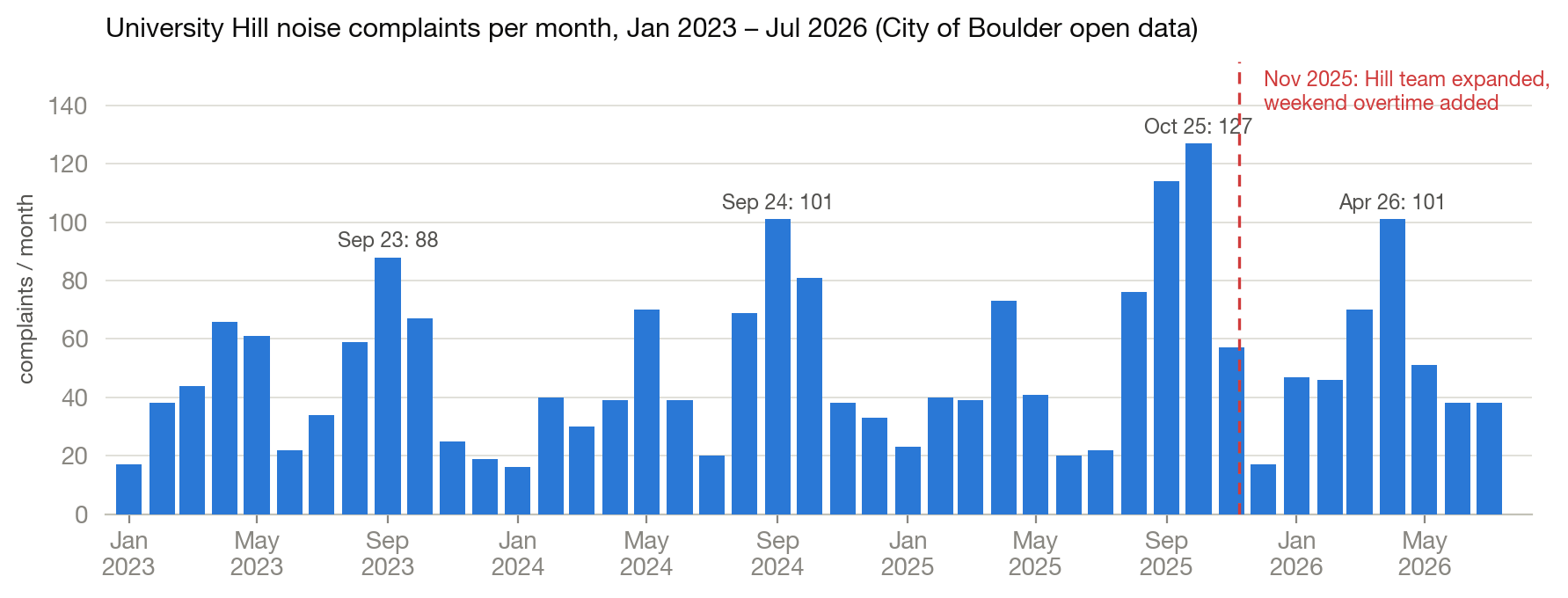
Noise complaints on University Hill hit record levels in 2026 — up 50% over last year, despite increased police enforcement. Half of all complaints happen in just fifteen hours a week. A small set of repeat addresses drives the problem. We publish who, where, and when — from the city’s own data.
Get each report when it publishes
We send an email when a new report goes out and when the watch list advances — a few times a year, nothing else.
You’re on the list. We’ll write when the next report publishes.
The list is used for these emails and nothing else, and we never publish resident names. We remove you the moment you ask.